A custom commerce platform engineered for 10,000+ marine SKUs — real-time supplier synchronization, a product compatibility engine no off-the-shelf platform ships, and catalog operations that run without a developer.
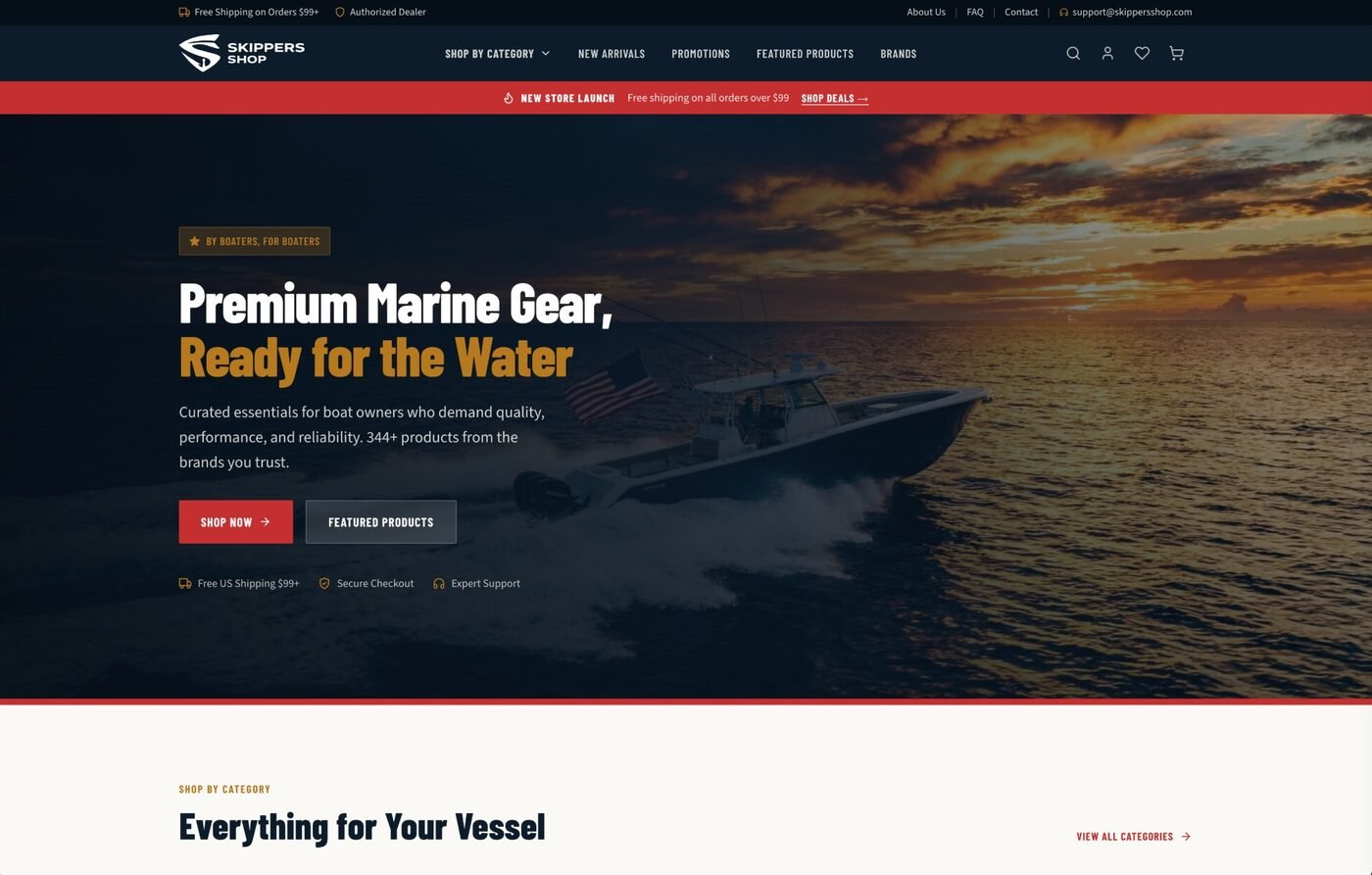
Skippers Shop is a specialty marine electronics retailer serving recreational boaters, offshore sailors, and commercial vessel operators across the US — carrying professional-grade navigation, communication, safety, and electrical equipment from the world's leading brands: Garmin, Furuno, Simrad, Icom, Lowrance, Humminbird, and more.
The challenge wasn't just building a shop. It was building a shop that understands how marine equipment actually works. A chartplotter doesn't pair with just any transducer. A VHF radio requires a specific antenna. A fish finder is defined by hull type, frequency, and connector — not just a model number. Generic e-commerce platforms treat every product the same way. Skippers Shop needed something that didn't.
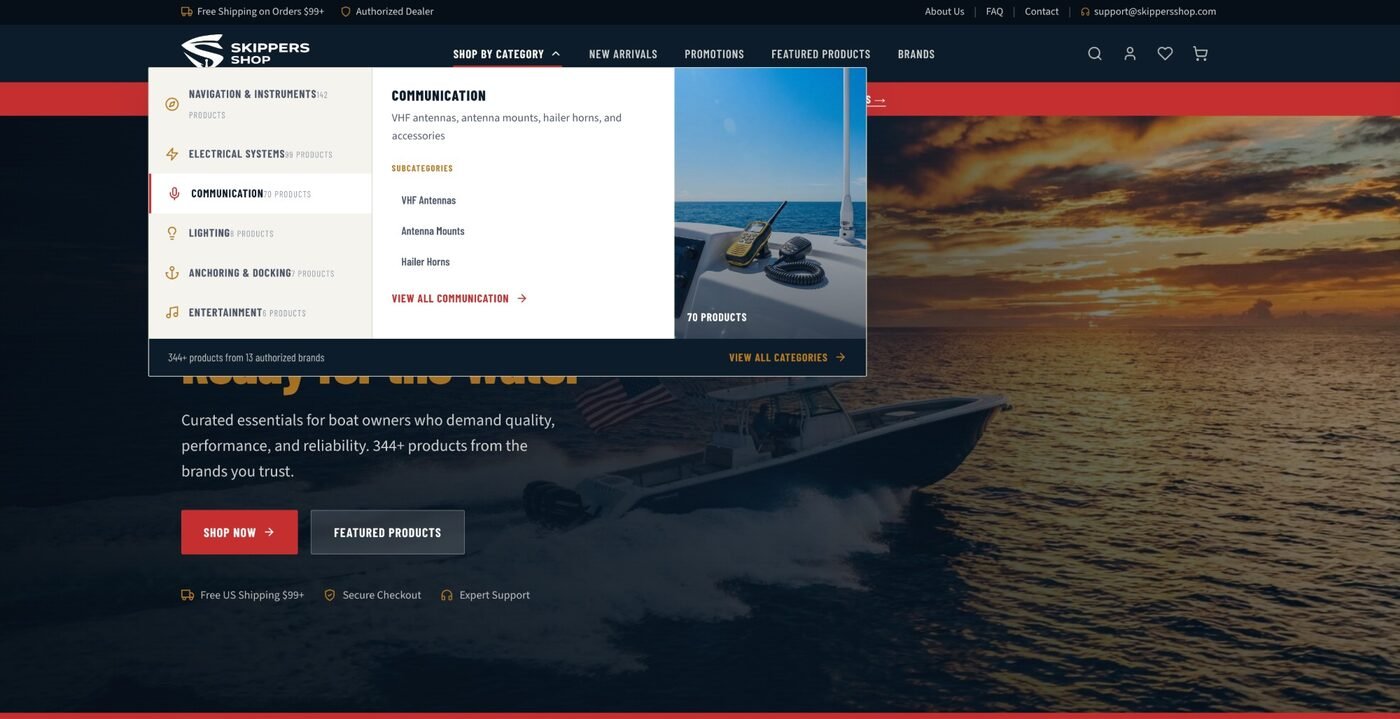
We designed and built a fully custom e-commerce platform from scratch — no Shopify, no WooCommerce — tailored entirely to the marine electronics vertical. Every architectural decision was made around the product catalog's complexity: deep taxonomies, brand-level specifications, cross-product compatibility, and a supplier network whose data changes daily.
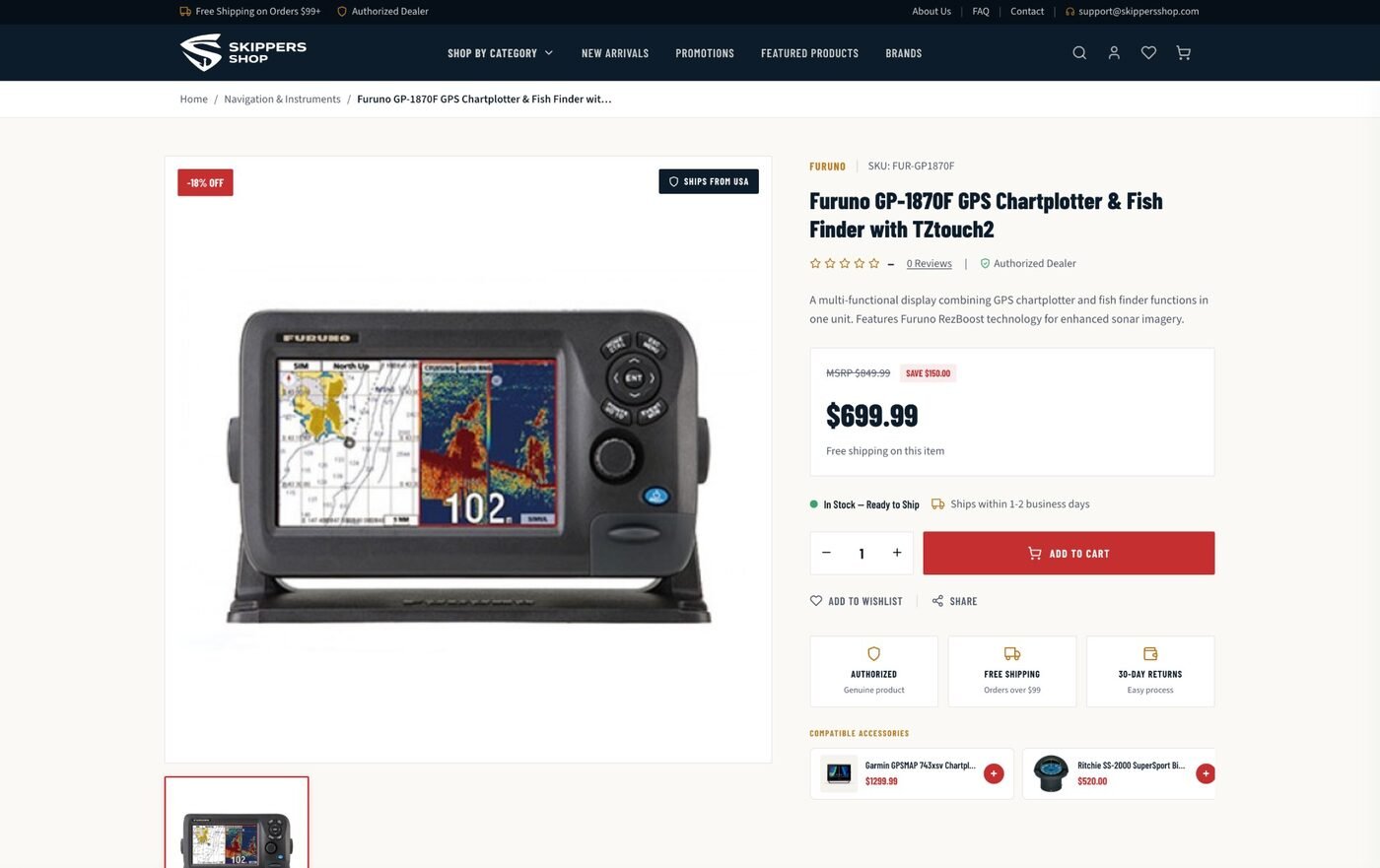
We modeled hard product relationships at the data layer — transducer-to-plotter compatibility, antenna-to-VHF pairing, hull type constraints — and surface them on every product detail page as a native "Compatible With / Requires" strip. Customers know immediately what they need. Support load drops. Confidence at checkout goes up. This exists nowhere in standard e-commerce tooling.
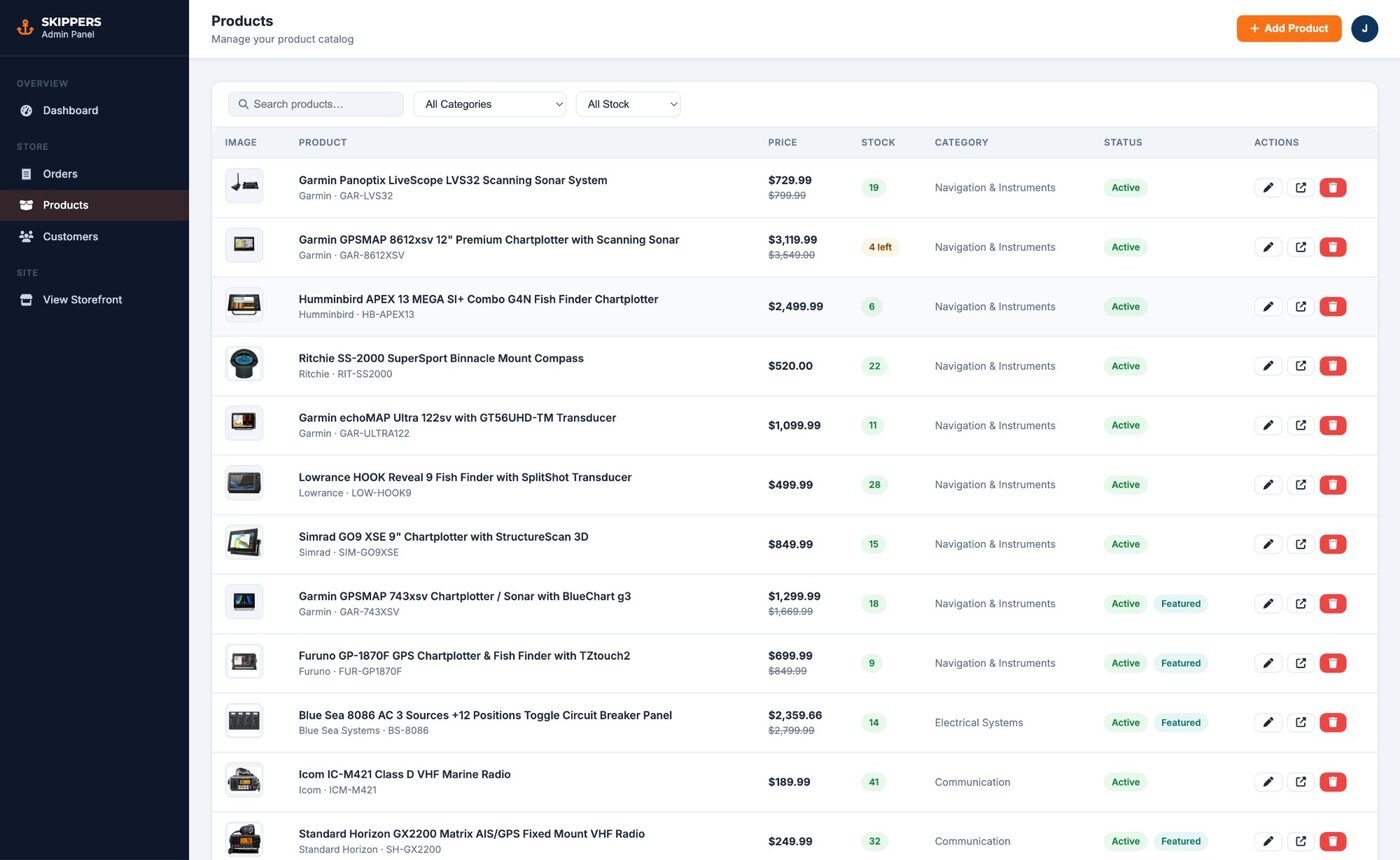
The admin panel was built with the same care as the storefront. Merchants can add new products, assign categories, set pricing, manage stock levels, and publish — in minutes, without touching code. The product editor supports specification key-value pairs, multiple image URLs, featured flags, and compare-price display for sale badges.
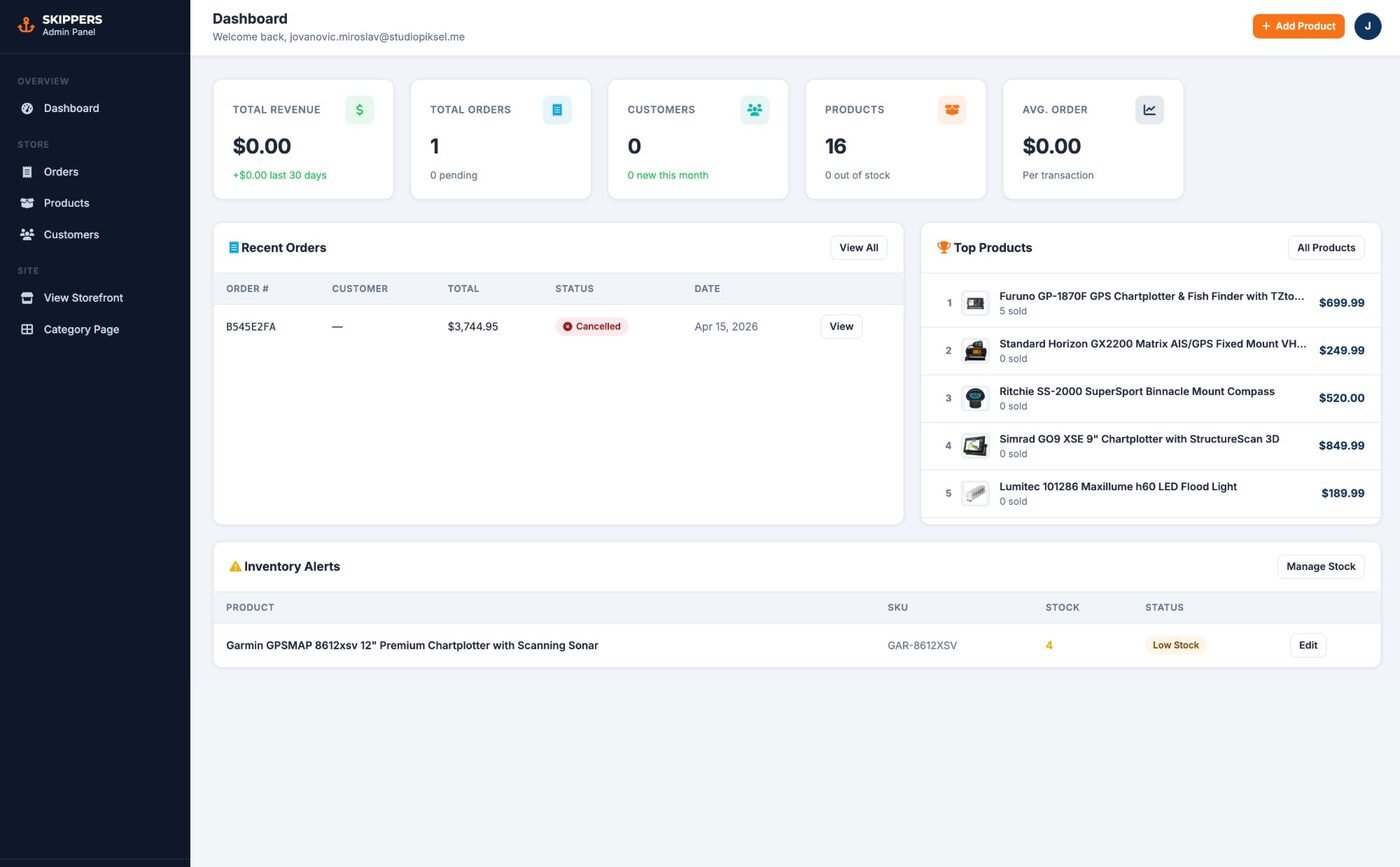
Orders, customers, inventory alerts, and revenue metrics are all visible from a single dashboard — real-time, no third-party analytics required.
Marine equipment availability shifts daily — products go in and out of stock at distributors, prices change with manufacturer promotions, new SKUs appear mid-season. The old approach is a spreadsheet export on Monday morning. We built something fundamentally different.
The decision to go framework-free on the frontend was deliberate. At 10,000+ products, raw performance matters more than developer convenience. No React hydration cost, no bundle bloat — just fast HTML and progressively enhanced JavaScript that loads instantly on any connection.
The platform is feature-complete and running as a live demo environment — storefront, admin, import pipeline, and supplier sync all operational. Commercial launch is scheduled for 2026, with the full 10,000+ SKU catalog rollout as the final step.
"It looks and performs brutally well. What used to take hours of manual product entry and administration, we now handle in minutes through a single CSV upload."
Deep taxonomies, product compatibility rules, supplier feeds that change daily, B2B and B2C pricing in one system — if Shopify keeps saying no to your business model, that's exactly the kind of platform we build.